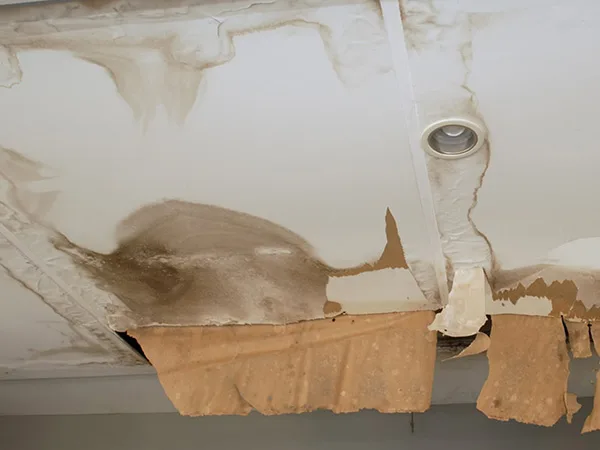


Years of hidden roof intrusion fed black mold inside the wall cavities of a large Belton home while the room air stayed at normal levels. How Emergency Mitigation Services found the source, proved it with independent laboratory testing, remediated 20+ rooms, worked directly with insurance carriers and adjusters, and helped turn a $0 claim denial into a six-figure recovery.
Project Overview
Years of slow water intrusion, hidden behind the walls
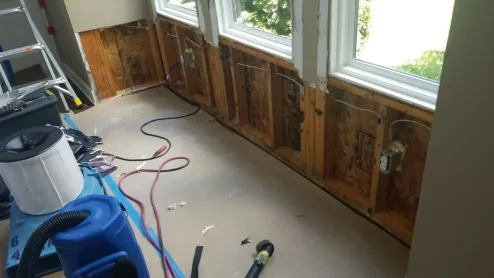
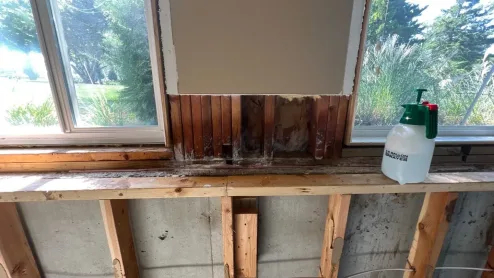
The homeowners contacted Emergency Mitigation Services after a family member’s ongoing respiratory and allergy symptoms led them to test the house for mold. What looked like an isolated problem turned out to be the result of years of slow water intrusion through a tile roof: damaged and cracked tiles, failed flashing around the chimney, and worn seals at windows and downspouts had let moisture in repeatedly over time. An earlier leak above the master bedroom had been patched without a formal claim two years prior, but the underlying roof problem was never fully resolved. Moisture kept finding its way into the wall cavities, the attic, and down through multiple floors, feeding mold growth the family could not see. Critically, the air in the home’s living spaces often tested at or below normal outdoor levels. The contamination was not in the air the family breathed day to day. It was sealed inside the walls — which is exactly why it went undetected for so long. EMS’s scope covered the full property: source documentation, independent laboratory air and cavity testing, full containment, and structured remediation of more than twenty rooms across three finished levels and the attic, followed by independent third-party clearance testing to verify the home was safe to reoccupy.On-Site Inspection
Documenting the source before touching the mold
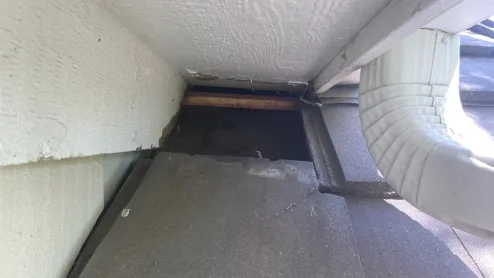
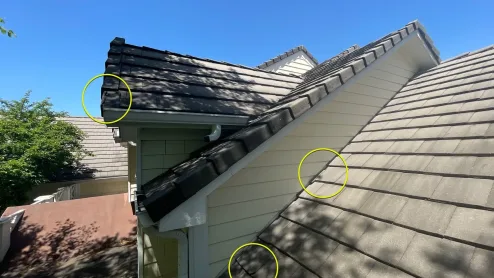
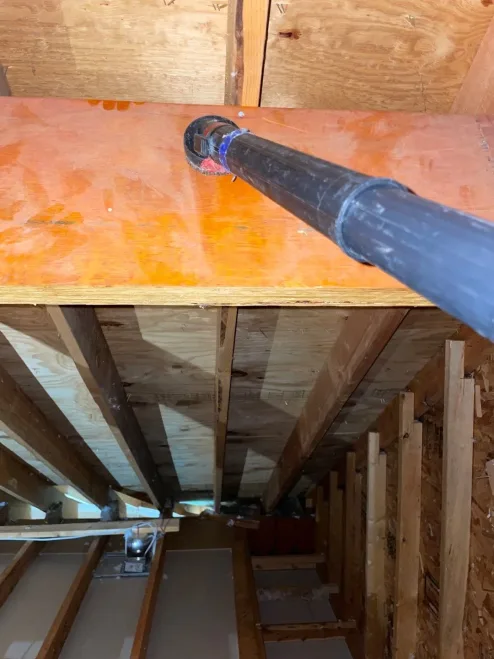
Fred Dohogne began on the roof, not in the house. Remediation work fails when the water source isn’t addressed first, so the team’s first move was a complete, timestamped photo survey of the roof system — capturing each cracked and displaced tile, the chimney flashing, the bay-window copper detailing, and the downspout failures that were letting water past the building envelope. That documentation mattered for two reasons. First, it told EMS exactly where moisture was entering, which drove the room-by-room remediation plan. Second, it created an objective, dated record of the roof’s condition — distinguishing storm-related tile damage from age and maintenance wear, and establishing a clear timeline of when the damage was visible. Inside, the team traced the water’s path from the attic down. Staining and active intrusion were visible in the attic framing and sheathing, the master bedroom and closet, the northwest bedroom, and several bathrooms — consistent with water tracking along the roof structure and into the wall cavities below.The EMS Team on This Project
Who led the project
This remediation was led by EMS’s project manager, who directed the room-by-room plan from the independent lab findings and the documented moisture map.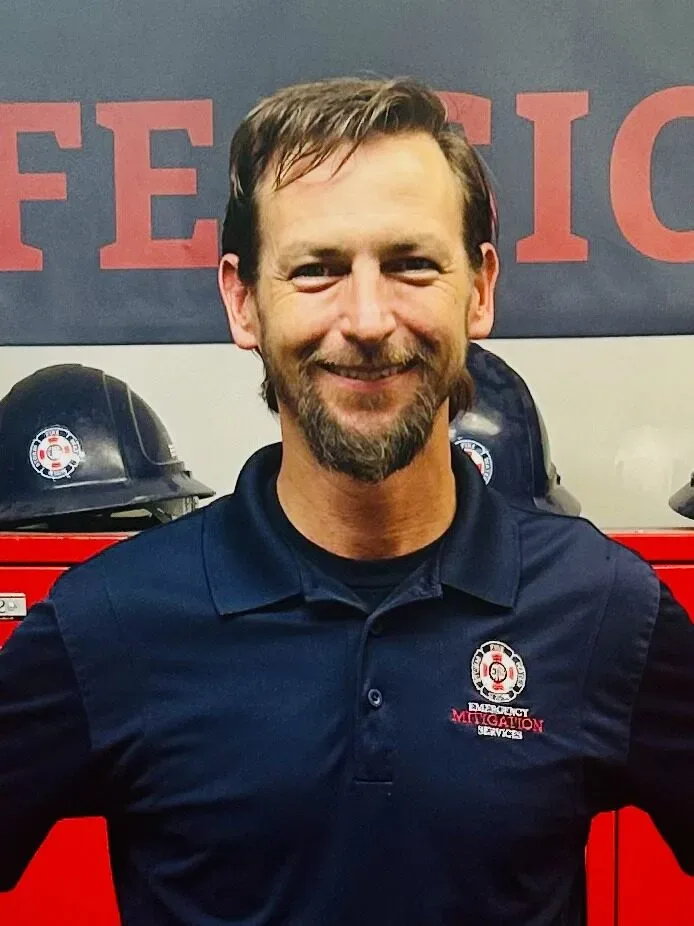
Fred Dohogne, WRT, AMRT
- Led the on-site roof inspection and the full photo documentation of every water-intrusion point on the property, and supported the project throughout on leak-source identification and on-site troubleshooting.
- Holds IICRC certifications as a Water Restoration Technician (WRT) and Applied Microbial Remediation Technician (AMRT).
- Draws on a background in insurance and claims work to document each property thoroughly and accurately.
Independent Verification
The numbers behind the diagnosis
Before remediation began, the property was independently assessed by Axiom Service Professionals, with all samples analyzed by SanAir Technologies Laboratory, an AIHA-LAP accredited environmental lab. The pre-remediation round included 46 samples — 39 air and cavity cassettes plus 7 surface swabs. After the work was complete, a separate independent clearance round was collected and analyzed by the same accredited laboratory. This is what separates a documented remediation from a “we cleaned it up” claim: the contamination was measured by a third party before the work, and the result was verified by a third party after it. The pre-remediation results confirmed elevated levels of mold associated with chronic water damage, concentrated where moisture had collected: Stachybotrys (the “black mold” that grows on long-term wet, cellulose-rich material), Aspergillus/Penicillium, and Cladosporium — with Chaetomium and elevated ascospores present as additional water-damage indicators. The highest readings came from inside wall cavities and the attic, not from open room air.Before and after: the same home, measured twice
| Location | Dominant mold type | Before (ct/m³) | After |
|---|---|---|---|
| 1st-floor living room — wall cavity | Aspergillus / Penicillium | 43,333 | Within range |
| 1st-floor living room — wall cavity | Stachybotrys (black mold) | 34,667 | Within range |
| 2nd-floor SW bedroom — wall cavity | Stachybotrys (black mold) | 12,267 | Within range |
| West attic, 2nd floor | Cladosporium | 9,200 | Within range |
| Attic, NW corner bedroom | Too overloaded to analyze | — | Within range |
One attic sample came back so heavily loaded with contamination and debris that the laboratory could not complete a standard analysis and flagged it at the highest debris rating on their scale. When a lab cannot count a sample because there is too much in it, that is a measure of severity in itself.
For context, a clean indoor environment typically shows mold counts at or below the outdoor baseline. Wall-cavity readings in the tens of thousands, with confirmed Stachybotrys, indicate active, long-term moisture and the need for full containment-based remediation, not surface cleaning. The post-remediation clearance round confirmed the home was brought back within an acceptable range before the family returned.
Equipment & Technology
We utilized specific methods to isolate and eliminate the contamination.
- HEPA negative air machines — established and maintained negative pressure inside each containment zone, capturing airborne spores and preventing cross-contamination into clean areas. Carbon/charcoal pre-filters were added where odor control was needed.
- HEPA vacuums — used throughout the HEPA-sandwich cleaning process on all surfaces, framing, and sheathing.
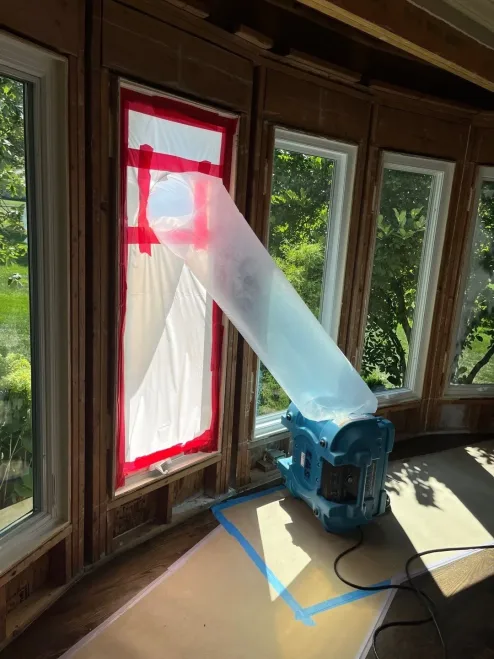
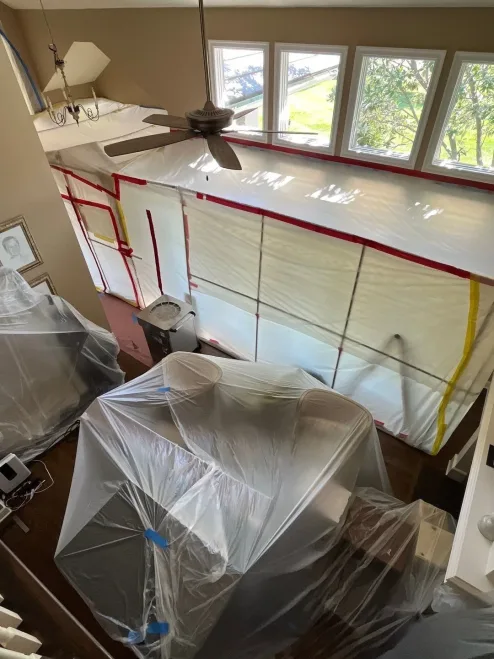
- Critical barriers & containment (IICRC S520) — 6-mil poly barriers built room by room to isolate each work zone; larger areas required full floor-to-ceiling chambers.
- Moisture meters & thermal imaging — used to verify framing and sheathing were dry before encapsulation, and to confirm the roof intrusion points carried moisture into the structure.
- Antimicrobial fogging — EPA List N disinfectant applied by air-wash and fogging after physical cleaning.
- Mold-inhibiting encapsulant — exposed framing and sheathing wire-brushed or sanded, then sealed to lock down any inaccessible residual growth.
Our Process
A whole-home remediation, worst areas first
EMS sequenced the work using the lab findings and the documented moisture map, starting with the most heavily contaminated areas and working outward, so the cleanest zones stayed protected the longest.- Containment & negative pressureEach affected room received critical barriers and a HEPA-filtered negative-pressure enclosure before any material was disturbed — the single most important step in keeping spores from spreading through a home this size during demolition.
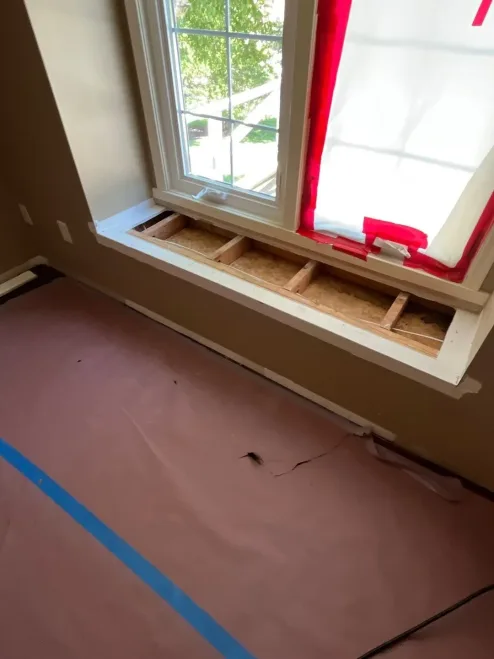
- Targeted material removalDrywall, casing, baseboard, and insulation were removed and extended a minimum of two feet past any visible growth. Saturated carpet and pad came out; bench seats and built-ins were pulled where moisture had collected behind them — guided by the lab data and visible staining, not guesswork.
- HEPA-sandwich cleaningEvery surface was cleaned using the HEPA-sandwich method: HEPA-vacuum all surfaces, clean surfaces using an EPA List N antimicrobial, then HEPA-vacuum a second time. Framing and sheathing were wire-brushed or sanded where growth was embedded in the wood.
- Air washing, fogging & encapsulationSurfaces were air-washed and fogged with antimicrobial disinfectant, then exposed framing and sheathing were sealed with a mold-inhibiting primer to encapsulate any inaccessible residual growth.
- Air filtration & independent clearanceNegative air filtration ran throughout the work and remained on 48 hours after completion in each zone, followed by free-air scrubbing for 24 hours before final sampling. An independent testing round performed post-remediation clearance. EMS does its own work and lets a third party verify the result.
Why Documentation Matters
From a denied claim to a six-figure covered loss
It starts with documenting the damage from day one. When this loss was first reviewed, the homeowners faced a denial. Zero dollars. EMS’s contribution was simple and powerful: a thorough, timestamped photo record of the roof and every intrusion point, paired with independent laboratory testing that quantified the contamination. With clear, objective documentation in hand, the homeowners were able to revisit the claim with their carrier. The outcome: approximately $91,000 in coverage secured across two claims, plus roughly $12,800 in additional living expenses — more than $100,000 in total recovery, from a starting point of $0.Results & Outcome
A safe, verified-clean home
- Source identified and documented — the roof intrusion points were mapped before remediation began, so the underlying water problem could be addressed, not just the visible mold.
- Contamination removed under containment — all affected materials removed and every surface cleaned under negative pressure, preventing spread during a months-long project.
- Independently verified clean — an accredited lab measured contamination exceeding 43,000 count/m³ in a wall cavity going in, and independent clearance testing confirmed mold levels were back within an acceptable range before the family returned.
- Prepared for reconstruction — with the structure dried, cleaned, and encapsulated, the home was returned to a stable condition and ready for the rebuild phase.
Project Images
From roof source to verified-clean framing