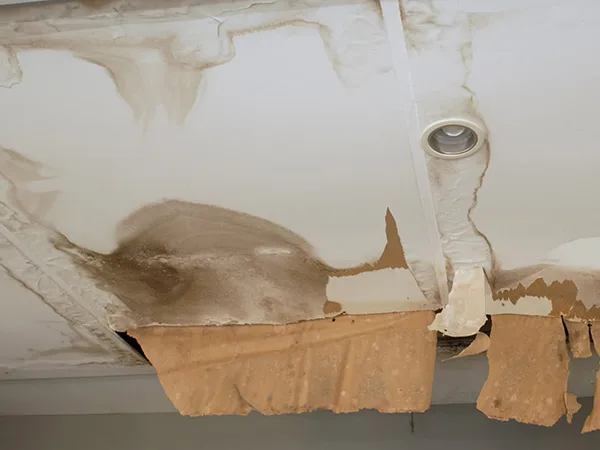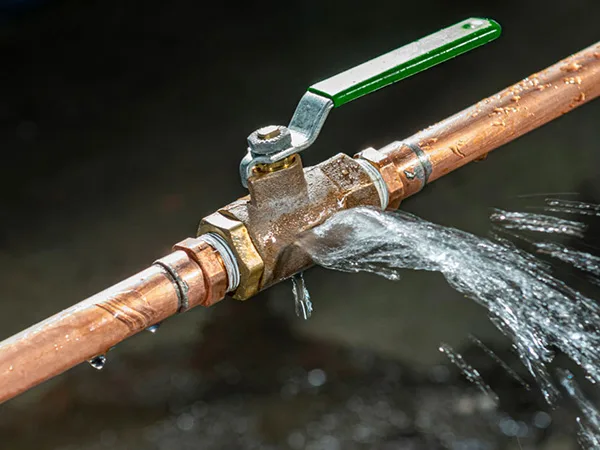


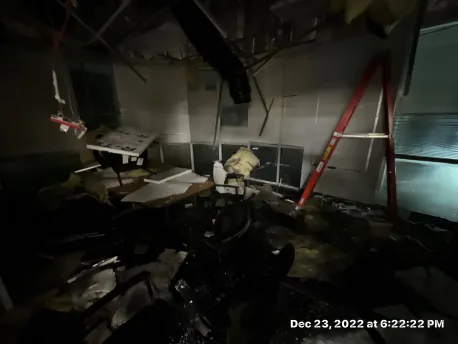
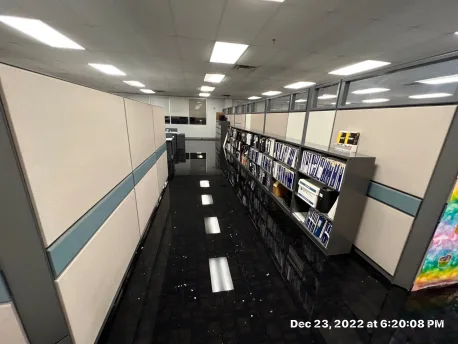
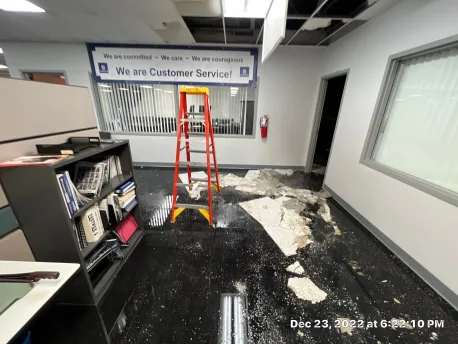
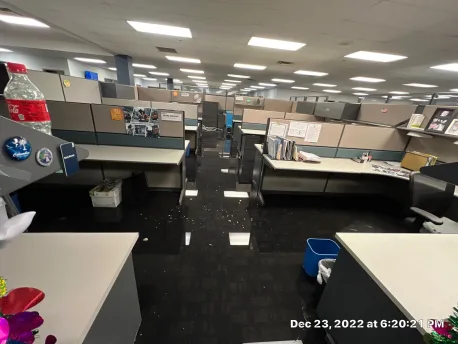
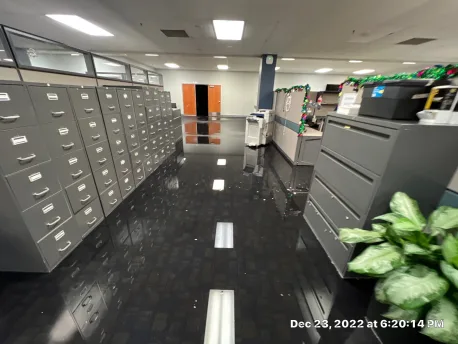
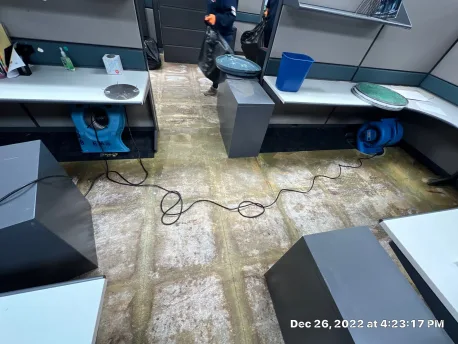
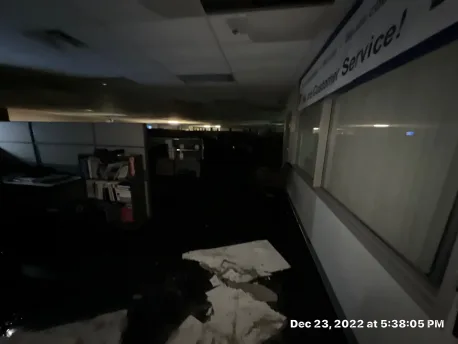
A hard freeze blanketed the Kansas City metro area on December 23, 2022, just in time for the holiday weekend. A fire-suppression line above a corner office at Husqvarna Construction Products in Olathe, Kansas froze, expanded, and split the pipe — flooding the office to about five feet deep and sheeting Category 3 water across more than 25,000 square feet of raised-access office flooring. What made this loss difficult wasn’t the water everyone could see — it was the data-cable channels beneath the floating floor, all of it submerged. EMS was on site the same evening and made one decision that shaped the entire project: dry the floor in place rather than tear it out.
Services Provided
Client
Husqvarna Construction Products
Job Location
Olathe, KS (Greater Kansas City)
Property Type
Commercial Office — Raised-Access Floor
Cause of Loss
Frozen fire-suppression line burst — Category 3 water
Date of Loss
December 23, 2022
Project Duration
~12-day structural dry-out
EMS Location
25K+
Sq ft affected
140
Air movers deployed
54
Monitoring positions
1,702
Crew hours logged
Project Overview
One frozen pipe, a five-foot flood, and a floor full of data cable
A hard freeze blanketed the Kansas City metro area on December 23, 2022, just in time for the holiday weekend. Cold air reached the fire-suppression line above a corner office at Husqvarna Construction Products in Olathe, Kansas. The water in the line froze, expanded, and split the pipe. The corner office filled to about five feet deep. The door opened inward, so the water pressure held it shut — the only way to drain the room was to break out a window from the outside with an axe. By then the water had already sheeted across the open floor, soaking carpet tile and pooling under cubicle runs that, a day earlier, had been a customer-service department decorated for Christmas. What made this loss difficult wasn’t the water everyone could see. The office sat on a raised access floor, and every data cable in the building ran in the channels beneath it — all of it submerged. EMS was on site the same evening and made one decision that shaped the entire project: dry the floor in place rather than tear it out.
Who Led the Project
Led on site by Eric Mann
This commercial water-mitigation project was led on-site by Eric Mann, Director of Operations and an IICRC Triple Master – certified technician; EMS is IICRC certified (Firm #59937490, verify at iicrc.org).
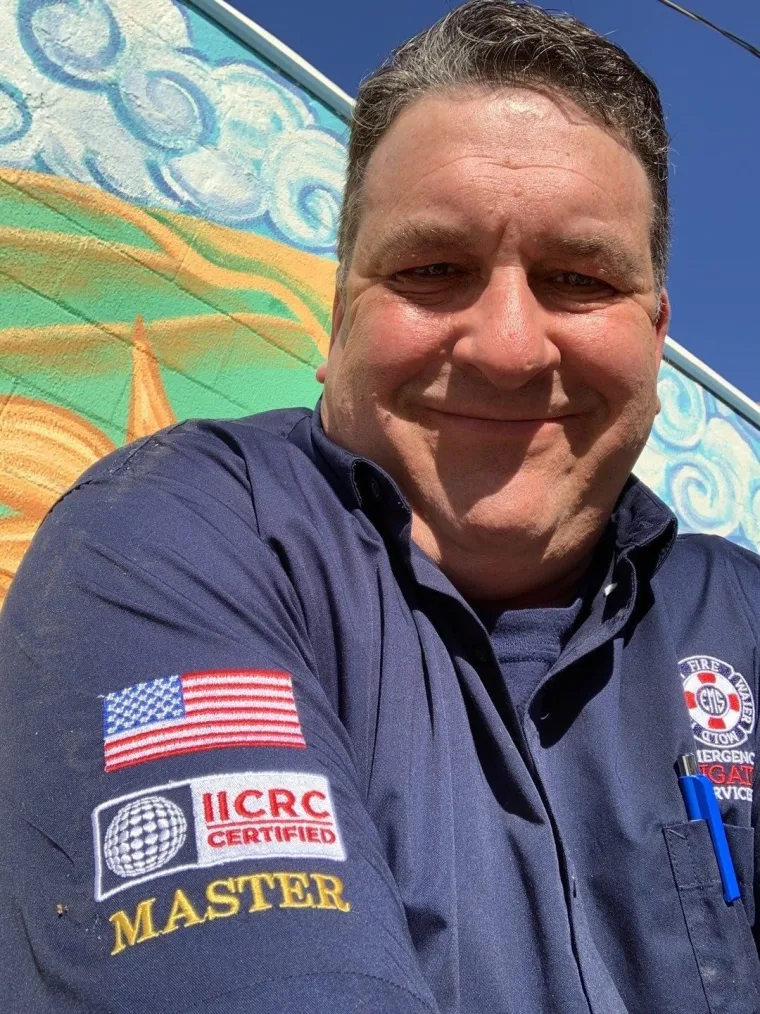
Eric Mann
Director of Operations · Project Lead · IICRC Triple Master
- Led the same-day/holiday emergency response and set the strategy to dry the raised floor in place instead of demolishing it.
- Engineered the directed heated-airflow method used to dry the sealed under-floor cable channels.
- Oversaw psychrometric monitoring across 54 positions and borescope verification of the channels before demobilizing.
- WATER DAMAGE RESTORATION TECHNICIAN
- ODOR CONTROL TECHNICIAN
- APPLIED MICROBIAL REMEDIATION TECHNICIAN
- COLOR REPAIR TECHNICIAN
- CARPET CLEANING TECHNICIAN
- APPLIED STRUCTURAL DRYING TECHNICIAN
- UPHOLSTERY AND FABRIC CLEANING TECHNICIAN
- CONTENTS PROCESSING TECHNICIAN
- FIRE AND SMOKE DAMAGE RESTORATION TECHNICIAN
- MASTER TEXTILE CLEANER
- MASTER FIRE & SMOKE RESTORER
- MASTER WATER RESTORER
Crew supervisor: Benjamin Sepesi. Owner Fred Dohogne — with more than 15 years in property-damage estimating — ran the moisture diagnostics and managed the project documentation.
The Challenge
The water you could see wasn’t the hard part
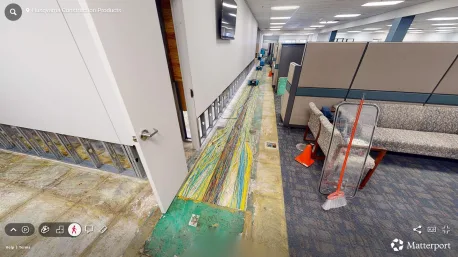
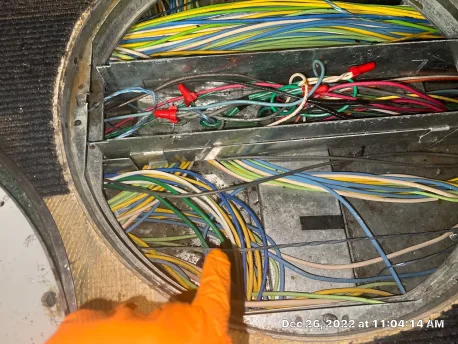
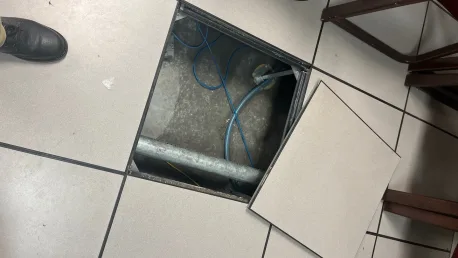
The office floated inches above the slab on a raised access floor — a system built so Ethernet and power runs stay accessible in the channels underneath. When water gets under those panels, it doesn’t stay where you can reach it. Here it ran down into the channels and filled them: long, mostly sealed runs of roughly 50 feet, packed with cable, all submerged. Two facts set the difficulty. The source — water from a fire-suppression line is treated as Category 3, the most contaminated class, because line water can be stagnant and may carry chemicals. And the structure — you can’t mop a floating floor dry, because the wet surface area lives in cavities you can’t open without dismantling the whole system. The conventional fix is demolition: pull tens of thousands of square feet of panels and pedestals, dry the slab, and rebuild. For a working office, that adds weeks of downtime on top of the reconstruction bill.
The Numbers Behind the Dry-Out
A documented drying operation, at scale
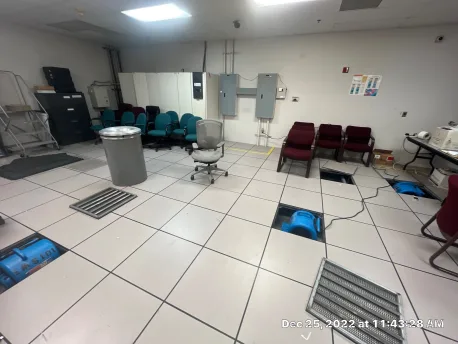
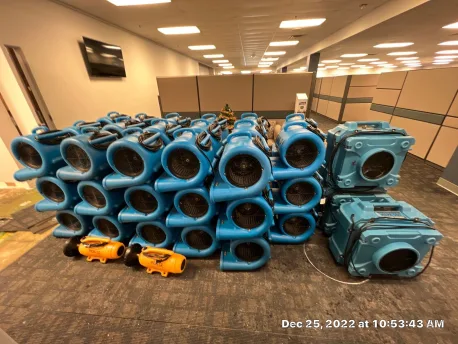
Holding a controlled drying environment across more than 25,000 square feet through a Kansas winter took equipment in quantity — and documentation to prove the result rather than assume it.
| Resource | Detail | Figure |
|---|---|---|
| Affected area | Raised-access office floor | 25,000+ sq ft |
| Air movers | Centrifugal, run ~12 days | 140 |
| Dehumidifiers | Including desiccant units | 33 |
| HEPA air scrubbers | 500–2,000 cfm | 14 |
| Monitoring positions | Daily psychrometric readings | 54 |
| Crew hours | 1,020 regular + 632 OT + 50 double-time | 1,702 |
Readings were benchmarked against outside-air and unaffected-room baselines, and a borescope confirmed the sealed channels — including isolating one persistent wet spot and targeting it until it met the dry standard. Drying a space you can’t see into only works if you can prove the result.
Equipment & Technology
What we used to dry it in place
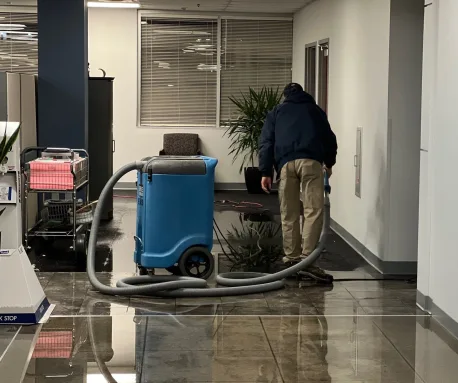
- Centrifugal air movers (140) — staged at one end of each under-floor run, and it points in the middle, to drive air the length of the channel.
- Dehumidifiers (33) — paired with the air movers so the air entering the channels was heated and dehumidified, not ambient — up to desiccant capacity.
- HEPA air scrubbers (14) — maintained air quality across the affected floor for the duration of the Category 3 dry-out.
- Portable extractors — pulled standing water out of the under-floor channels before structural drying began, and each day during the drying process as water migrated in the channels.
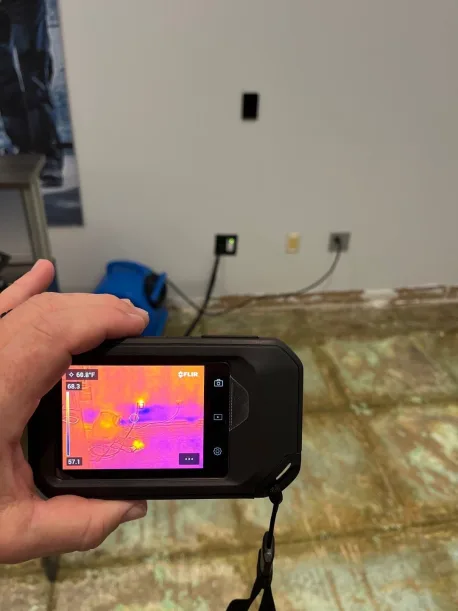
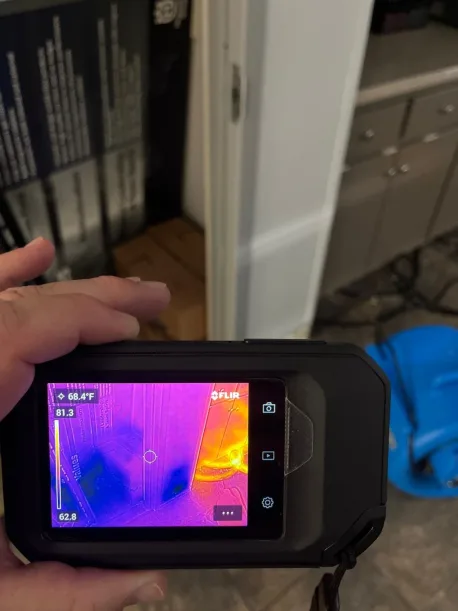
- FLIR thermal imaging — mapped hidden moisture behind surfaces that looked dry; cool signatures flag where to confirm with a meter.
- Borescope verification — inspected inside the sealed channels where no probe or sightline could otherwise reach, to confirm dryness.
Our Process
Turning the floor cavity into a drying duct
Extract standing water
→
Push heated dehumidified air
→
Capture moisture at far end
→
Verify with borescope
How EMS dried the raised floor in place: extract standing water, push heated dehumidified air through each ~50-ft under-floor channel, capture moisture at the far end, and confirm with a borescope before pulling equipment.
1
Extract the standing water
Extractors pulled pooled water out of the under-floor channels first, at the low points, before any drying began, and each day during the drying process as water migrated in the channels.2
Build directed, heated airflow
Air movers were set at one end of each ~50-foot run and paired with dehumidifiers, so the air entering the channel was warmed and dehumidified rather than ambient.3
Drive moisture out the far end
That warm air traveled the length of the cavity, picked up moisture, and carried it to the opposite end, where it was captured again.4
Verify with borescope and 54-point monitoring
Daily temperature, humidity, and grains-per-pound readings — benchmarked to outside and unaffected rooms — plus borescope inspection inside the sealed channels. One stubborn wet spot was located and targeted until it met the standard.5
Demobilize on a verified dry standard
Equipment came out only after the structure reached a documented dry standard — not a guessed one.Why It Matters
Why drying in place beat demolition
The expensive, slow part of a flooded raised-floor loss isn’t the water — it’s rebuilding the floor system and waiting out the downtime that comes with it. Because EMS dried the floating floor in place, Husqvarna replaced only its saturated carpet tiles. The raised-floor panels and pedestals stayed in service, and the company avoided a full floor reconstruction across the affected area.
The difference between mitigation and restoration.
EMS responded the day the loss occurred and ran the dry-out through the Christmas holiday — logging 632 overtime and 50 double-time hours — with much of the work scheduled for nights, weekends, and the holiday to keep the rest of Husqvarna’s operations moving. It’s the clearest example of our mitigation-first approach: save the structure, skip the demolition.
“One frozen pipe can turn into a quarter-million-dollar loss.”
— Fred Dohogne, Owner, Emergency Mitigation Services
Results & Outcome
The floor stayed. The business kept moving.
- Floating floor saved — client replaced only saturated carpet tiles; the floor system stayed in service.
- Verified dry, not assumed — 54 monitoring positions plus borescope confirmation of the sealed channels.
- Same-day, holiday response — on site Dec 23, 2022 and running through Christmas and New Year’s Day to limit disruption.
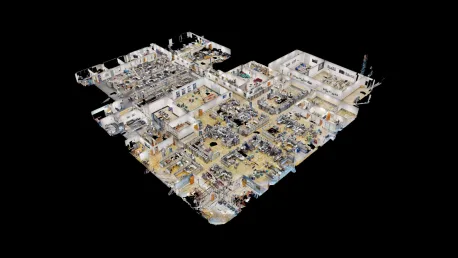
- Permanent documentation — Matterport 3D scan and measured floor plans recorded the full affected area.
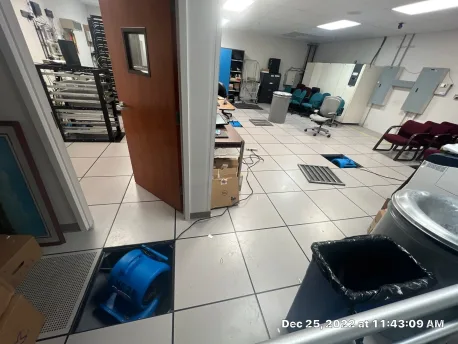
Project Images
Photos from mobilization to documentation
Questions, Answered
Commercial water damage: what people ask
What caused the water damage at the Husqvarna Olathe facility?
During the deep freeze on December 23, 2022, a fire-suppression line above the ceiling froze and burst inside a corner office. The room filled with roughly five feet of water, and Category 3 water spread across more than 25,000 square feet of raised-access office flooring.
How do you dry a raised access floor without removing it?
Emergency Mitigation Services set up a directed heated-airflow system. Air movers paired with dehumidifiers pushed warmed, dehumidified air through the roughly 50-foot channels beneath the floating floor, extractors captured pooled water at the low points, and a borescope verified that each channel reached a dry standard before equipment was pulled.
Why dry a floating floor in place instead of demolishing it?
Demolition would mean removing tens of thousands of square feet of raised-floor panels and pedestals and rebuilding the entire system, plus extended downtime for a working office. Drying in place let Husqvarna replace only its saturated carpet tiles while the floating-floor structure stayed in service.
How did EMS confirm the structure was actually dry?
Crews logged temperature, relative humidity, and grains-per-pound readings across 54 monitoring positions, compared against outside-air and unaffected-room baselines, and used a borescope to inspect the sealed under-floor channels.
What is Category 3 water?
Category 3 is the most contaminated water classification in the restoration industry. Water from a fire-suppression system is typically treated as Category 3 because it can be stagnant and may carry chemicals. Freeze events like this one are preventable in many buildings — see our guide to preventing frozen pipes in winter.
Does EMS respond to commercial losses on holidays and after hours?
Yes. EMS was on site the day the loss occurred, December 23, 2022, and ran the drying operation through the Christmas holiday, logging 632 overtime hours and 50 double-time hours.